A practical guide to vibration monitoring, including equipment and building vibration, construction monitoring, occupational exposure and the isolation and control measures used where problems are identified.
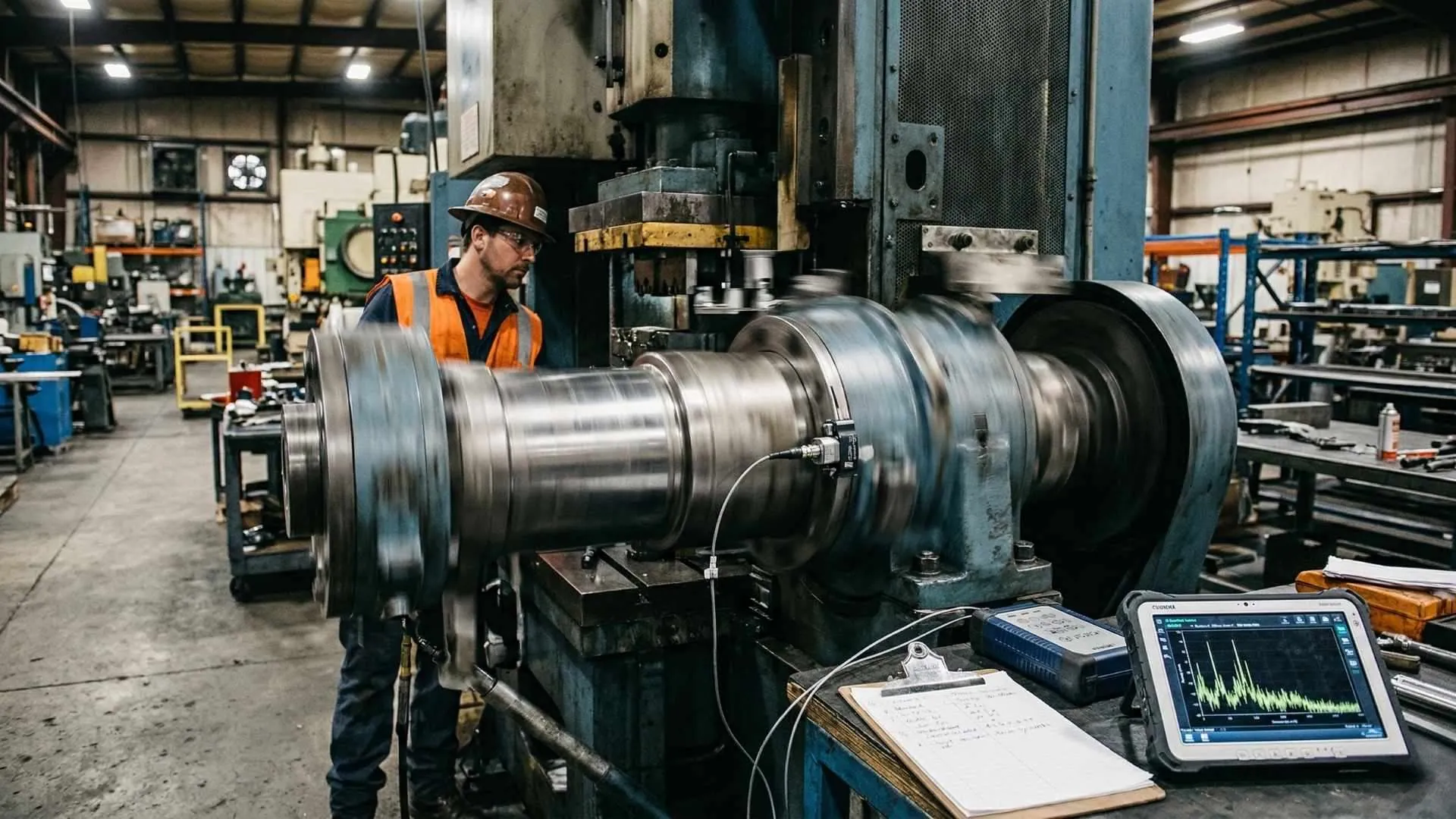
Vibration monitoring is the measurement of vibration magnitude, frequency and, where useful, time history, to understand where vibration is coming from, how it is transmitted, and whether it may affect people, buildings, equipment or processes. The results inform whether control measures, further assessment, or no action at all, are needed.
Vibration monitoring is used in several distinct contexts: on equipment and plant, in buildings and vibration-sensitive spaces, on construction and civil engineering sites, and for occupational exposure to hand-arm and whole-body vibration. Each has its own measurement approach and criteria, covered below.
Vibration from rotating or reciprocating equipment, pumps, motors, compressors and similar plant, can be transmitted through its supporting structure to adjacent equipment, occupied spaces or sensitive processes. Monitoring identifies the dominant sources and how vibration is being transmitted, which informs whether isolation, a change to equipment support, or other control measures are needed.
Vibration levels can also change with operating conditions; load, speed or process changes, and start-up or shutdown, can all affect behaviour. Resonance, where an operating frequency aligns with the natural frequency of a structure or component, can amplify vibration significantly and is an important factor in assessing risk.
Vibration can enter a building from nearby machinery, road or rail traffic, or other external sources, and travel through foundations, floors and other structural elements. This matters particularly where a building houses vibration-sensitive equipment or processes, common in pharmaceutical, laboratory and precision manufacturing environments, or where occupied spaces are affected.
How vibration is transmitted depends on ground conditions, structural stiffness and the building's construction; soft ground or lightweight structures can amplify vibration, while stiffer foundations tend to reduce it. Monitoring establishes the actual transmission path and levels, which informs whether isolation or other structural control is required.
Construction vibration monitoring measures vibration from activities such as piling, demolition and heavy plant at nearby buildings or sensitive locations. Monitoring criteria are typically defined by the project specification, planning requirements or the applicable vibration guidance for the development. Measurements are taken using ground vibration sensors at agreed locations, typically expressed as peak particle velocity (PPV), providing defensible data for contractors and reducing the risk of disputes with neighbouring occupiers.
Vibration monitoring can also assess human exposure. Hand-arm vibration (HAV) is transmitted through the hands and arms, and is commonly associated with powered hand tools and similar equipment. Whole-body vibration (WBV) is transmitted through the seat or feet, and is commonly associated with vehicles, mobile plant, platforms and seated operators.
In Ireland, occupational vibration is covered under Part 5, Chapter 2 of the Safety, Health and Welfare at Work (General Application) Regulations 2007. Exposure is expressed as frequency-weighted acceleration over an 8-hour reference period, A(8). The exposure action value for hand-arm vibration is 2.5 m/s² A(8), with an exposure limit value of 5 m/s² A(8). For whole-body vibration, the exposure action value is 0.5 m/s² A(8), with an exposure limit value of 1.15 m/s² A(8).
Vibration is typically measured as acceleration, velocity or displacement, depending on the frequency range and the purpose of the assessment, together with the frequency content and, where relevant, how levels change over time. A vibration survey establishes levels at defined locations to build a baseline, diagnose an existing issue, verify compliance against agreed criteria, or inform the design of control measures.
Where monitoring shows that vibration needs to be controlled, the appropriate solution depends on the source characteristics, the forcing frequency, the mass of the equipment involved, the supporting structure and the level of isolation actually required. Typical measures include correcting the issue at source, resilient mounts, spring isolators, inertia bases, structural isolation or decoupling, damping, and changes to equipment support or operating conditions. Where the equipment is also being enclosed for noise control, isolation has to be designed alongside the enclosure rather than as an afterthought; our guide to acoustic enclosures covers how the two interact.
Passive isolation, using mechanical elements such as springs and resilient mounts, does not require external power and is suitable for most industrial and building-services applications. Active isolation, using sensors and actuators to counteract vibration in real time, is reserved for highly sensitive environments where passive methods cannot achieve the required performance. Isolation is usually one part of a wider industrial noise-control strategy alongside source treatment, barriers and enclosures, covered in our guide to industrial soundproofing.
Need help with machinery or structure-borne vibration? Allegro Acoustics investigates machinery vibration and structure-borne noise as part of industrial noise-control projects, from source identification and measurement through to isolation and engineered control measures.
Vibration monitoring establishes what is actually happening at a site, on a piece of equipment, or for an exposed employee. Where the results indicate a genuine risk to people, buildings or sensitive equipment, the next step is usually a more detailed assessment; an occupational vibration exposure assessment where people are affected, or an engineering-led review where the concern is equipment or structures.
Vibration monitoring is the measurement of vibration magnitude, frequency and time history to understand where vibration is coming from, how it is transmitted, and whether it may affect people, buildings, equipment or processes.
Vibration monitoring is used for equipment and plant, buildings and vibration-sensitive spaces, construction and site works, and occupational exposure from hand-arm and whole-body vibration.
Construction vibration monitoring measures vibration from activities such as piling, demolition and heavy plant at nearby buildings or sensitive locations. Monitoring criteria are typically defined by the project specification, planning requirements or the applicable vibration guidance for the development.
Hand-arm vibration (HAV) is transmitted through the hands and arms, commonly from powered hand tools. Whole-body vibration (WBV) is transmitted through the seat or feet, commonly from vehicles, mobile plant and platforms. Both are assessed against separate exposure action and limit values.
Vibration isolation is typically needed where measurement shows that vibration from a source is being transmitted to people, structures or sensitive equipment at levels likely to cause disturbance, damage or non-compliance, and where correcting the source alone is not sufficient.
Where the concern involves people rather than equipment or structures, that is usually best addressed as part of a wider workplace noise and vibration risk assessment.
Need a workplace noise or vibration risk assessment? Allegro Acoustics provides workplace and occupational noise surveys, personal dosimetry, noise mapping and hand-arm and whole-body vibration assessments, together with practical guidance on controls and compliance.

Your enquiry is on its way. We'll be in touch shortly.