Industrial soundproofing reduces noise at source and along its transmission path using engineered measures such as acoustic enclosures, barriers, absorption and vibration isolation. This guide explains how these controls are selected and applied in factories, power stations, pharmaceutical facilities, data centres and other industrial environments.
“Industrial soundproofing” is a commonly used term for the engineering measures used to reduce noise from industrial plant and machinery. In engineering practice, the appropriate solution depends on the source, the transmission path, the receiver and the reduction actually required.
Effective industrial noise control starts by understanding the source, how the sound or vibration travels, and the receiver that needs to be protected. The receiver is not always an employee standing beside the machine. It may be another part of the same workplace, an occupied room elsewhere in the building, a nearby residential property, a site boundary, or noise-sensitive equipment that needs a stable acoustic or vibration environment.
Depending on where in that chain a problem is best solved, industrial soundproofing can mean controlling noise at the source itself, along the path it travels, or at the receiver end. The right combination is an engineering decision, not a fixed recipe.
It is tempting to specify an enclosure, a barrier, a set of acoustic panels, a silencer or a set of vibration mounts before the actual noise problem has been established. This is one of the most common ways that industrial noise reduction goes wrong: the treatment may do very little if it is not addressing the dominant source, or it may cost far more than the problem actually required.
A more reliable sequence is to measure the noise, identify the dominant source or sources, understand the frequency characteristics where they affect the choice of treatment, quantify what each source actually contributes at the receiver, establish the reduction required to meet the relevant criterion, select the engineering control, or combination of controls, proportionate to that reduction, and verify the result once it is in place.
Noise surveys establish what is actually happening on site, and acoustic modelling can then predict how a proposed treatment would perform before anything is bought, so that money is spent on the source that is actually responsible rather than on the equipment that happens to be easiest to reach.
In Ireland, workplace noise exposure falls under the Safety, Health and Welfare at Work (General Application) Regulations 2007. These values describe personal daily noise exposure, not a room sound level, and apply to what an individual worker is exposed to over their working day:
When exposure reaches or exceeds these values, employers must assess the risk, implement controls and, where relevant, provide hearing protection.
Environmental noise requirements are less uniform. A facility operating under an Industrial Emissions Licence may have noise conditions imposed through that licence and enforced by the Environmental Protection Agency. Other industrial sites may instead be subject to planning conditions or other environmental noise requirements. The applicable criterion, and who enforces it, therefore depends on the specific facility and its regulatory context, rather than a single limit that applies to every industrial site.
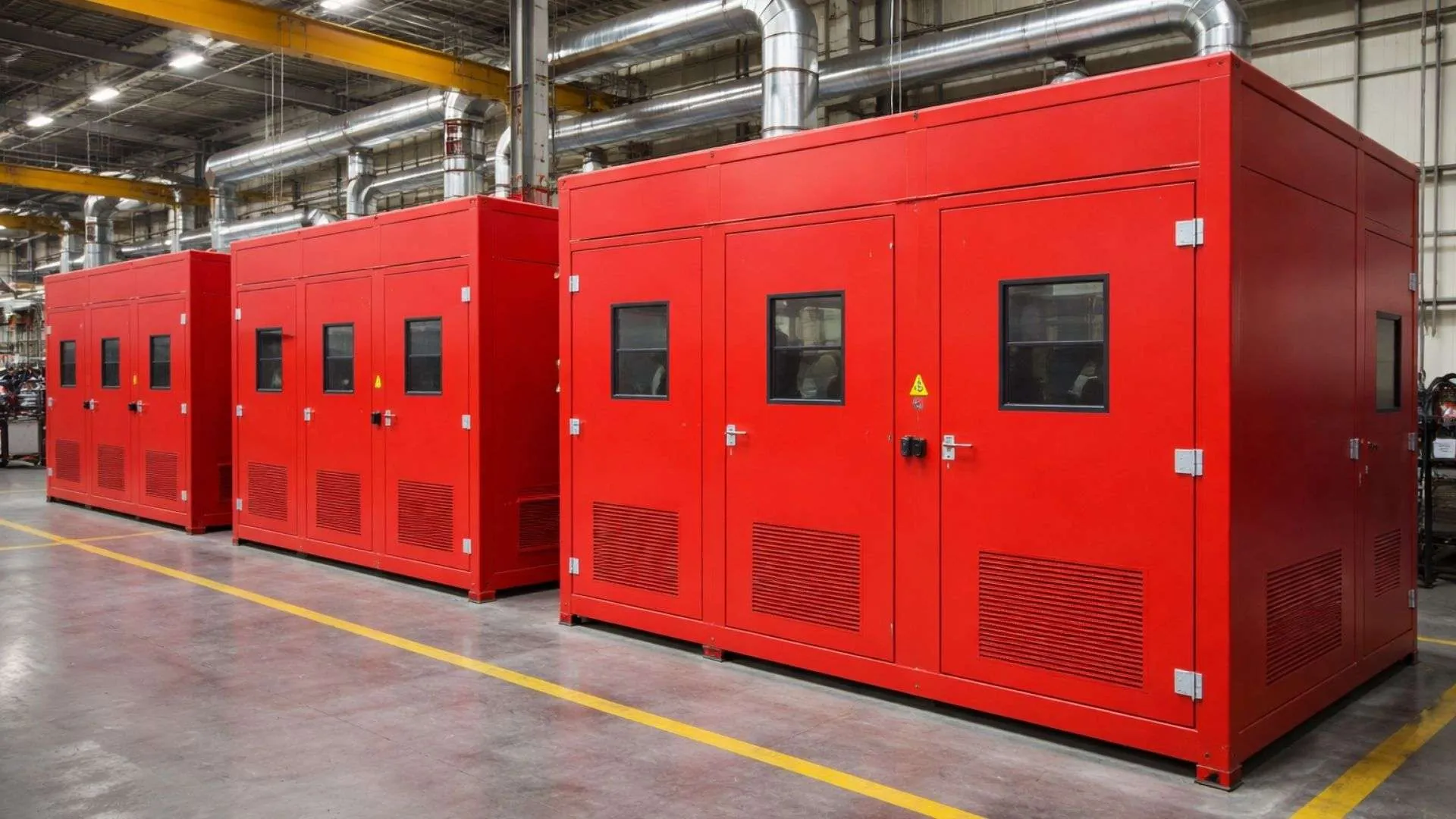
An acoustic enclosure is one of the most common industrial noise-control measures, and typically combines several elements: a panel construction with enough mass to resist transmission, internal absorption to control reflections inside the enclosure, airtight seals at joints and access points, and doors or access panels detailed to the same standard as the rest of the enclosure.
Ventilation and cooling are usually the hardest part of the design. Most enclosed equipment, generators and compressors in particular, needs airflow for cooling, and that airflow has to get in and out somewhere. Any opening or penetration, a cable gland, a pipe penetration, a ventilation louvre, is a potential weak point, and an enclosure is only ever as effective as its weakest transmission path. Vibration from the enclosed equipment also has to be addressed separately, since a well-sealed enclosure sitting on a vibrating base can still radiate noise through the structure it is fixed to.
Maintenance access matters just as much as the acoustic design: an enclosure that gets left open, or whose doors do not reseal properly after a service visit, stops performing the moment that happens. Our guide to acoustic enclosures covers enclosure design, construction and specification in more depth.
A barrier is a different tool to an enclosure and works differently: rather than fully containing a source, it breaks the direct line of sight between the source and the receiver. Barrier performance depends on its height and position relative to both the source and the receiver, since the geometry between the three determines how much of the source is actually screened.
Performance also varies with frequency. Low-frequency noise diffracts around the top and edges of a barrier more readily than high-frequency noise, so a barrier that works well against a high-pitched fan may do far less against a low-frequency generator or compressor. Gaps, gates and openings undermine performance just as they do for enclosures, and reflections off nearby hard surfaces can reduce the effective benefit even where the direct path is fully screened.
Barriers are frequently used around external plant such as generators, chillers and compressors, where a full enclosure is not practical or where the priority is shielding a specific nearby receptor rather than containing the source completely.
Sound insulation and sound absorption are frequently used interchangeably, but they do different jobs. Sound insulation reduces the transmission of sound through an element or an enclosure, from one side to the other. Sound absorption reduces reflected sound within a space, by converting sound energy into heat rather than reflecting it back.
Adding absorbent panels to a factory floor can noticeably reduce reverberant noise and improve conditions for the people working there, but it does not insulate that space from an adjacent one, and it does little to reduce the level radiated to a neighbour outside. The two need to be considered separately, and a specification that only addresses one will not solve a problem that actually requires the other.
Porous absorbers such as mineral wool are effective at absorbing sound within a space, but mineral wool on its own does not provide the mass needed for sound insulation; it needs to be combined with a dense outer layer to control transmission. Acoustic wall panels and ceiling baffles work the same way, adding absorption area to reduce reverberation time, and enclosure linings serve the same absorptive role inside an enclosure.
Silencers and attenuators are used where air has to move but the noise it carries has to be controlled: ventilation openings, air intakes and exhausts, ducts, fans, and generator or engine exhausts and cooling air paths. Acoustic louvres serve a similar purpose at enclosure and building openings, attenuating noise while still allowing airflow through.
The acoustic performance of a silencer or louvre always has to be balanced against airflow, pressure drop, heat rejection and the operating requirements of the plant it serves. A silencer that achieves a large noise reduction but restricts airflow too far can cause a generator to overheat or a fan to work harder than intended, so selection is a joint acoustic and mechanical decision rather than an acoustic one alone.
Vibration is a different problem to airborne sound, though the two are often linked. Rotating and reciprocating machinery can transmit mechanical energy directly into floors, steelwork, foundations and pipework, and that vibration can then radiate as noise somewhere else in the building entirely, well away from the original source.
Typical measures include resilient mounts, inertia bases, structural isolation or breaks, and flexible connections on pipework and ductwork crossing an isolated floor or frame. None of these is a generic component chosen by thickness alone: an isolation system has to be selected against the equipment’s mass, its operating frequency and the dynamic loads it produces, since a mount that works well for one machine can be the wrong choice entirely for another. Our guide to vibration monitoring covers how vibration risk is identified and assessed in more detail.
The right measure depends on the dominant source, its frequency content, the reduction actually required, the geometry between source and receiver, whether the noise is airborne or structure-borne, the process and operational requirements of the plant involved, its ventilation and thermal requirements, the maintenance and operational access needed, the space available, and practicality and cost.
In practice, the answer is often a combination rather than a single product: a partial enclosure paired with a silencer on the cooling air path, a barrier combined with treatment at the source itself, a full enclosure paired with vibration isolation for the equipment inside it, or local absorption treatment alongside a separate reverberation-control measure for the wider space. Treating this as a single-product decision is one of the most common ways a scheme ends up either under-performing or considerably more expensive than it needed to be.
Industrial noise control should normally finish with verification rather than assumption. Post-installation measurement, using the same method as the original survey, establishes whether the intended reduction was actually achieved, whether workplace exposure has reduced as expected, and whether the relevant boundary or receiver criteria are now satisfied.
Verification also has a diagnostic value: it is common for treating the dominant source to reveal a second source that was previously masked, and post-installation measurement is how that becomes apparent rather than something discovered later from a fresh complaint.
Across all of the measures above, the same three-part logic applies: control noise at source, interrupt the transmission path, or protect the receiver. Most real industrial noise control problems are solved with some combination of the three, chosen once the source has been identified and the required reduction has been established, rather than by defaulting to whichever measure is best known or easiest to buy.
Need help with an industrial noise problem? Allegro Acoustics provides industrial noise control from source identification and acoustic modelling through to engineered control design, installation and performance verification.

Your enquiry is on its way. We'll be in touch shortly.