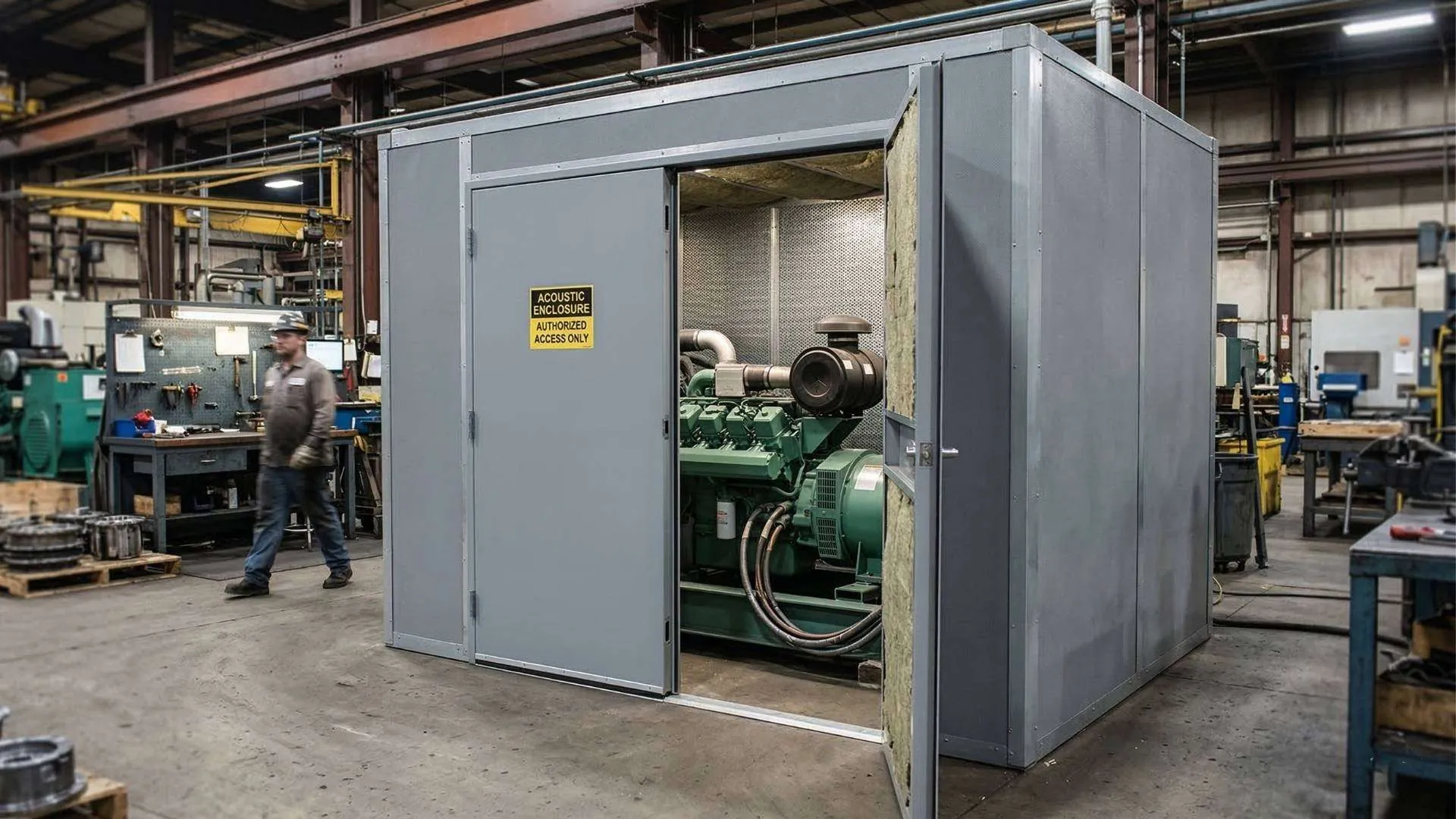
An acoustic enclosure controls noise close to its source, combining sound-insulating construction with internal absorption to contain a noisy machine. A working enclosure still has to let the equipment inside breathe, be accessed for maintenance and operate safely, so it has to be designed around the actual source and the reduction it needs to achieve, not built to a generic specification.
Noise from industrial machinery represents a regulatory, occupational health and environmental risk requiring management. In pharmaceutical plants, data centres and manufacturing facilities, industrial equipment often produces continuous high sound pressure levels that need to be brought under control.
Acoustic enclosures are one of the most effective ways to control noise at source, but how much they actually achieve depends on the source spectrum, the enclosure construction, its openings, its seals, its ventilation paths, structural transmission into the surrounding building, and the quality of the installation. There is no single figure that applies across all of these variables.
An acoustic enclosure is a specially designed, insulated structure that covers noisy machinery, combining sound-insulating construction with internal absorption to reduce airborne noise and control vibration. It can be a small cabinet around a single pump or a full walk-in enclosure housing a generator, and it is used across industrial settings to reduce noise at source, protecting personnel and supporting regulatory compliance.
The reduction an enclosure actually delivers at a given location is described as its insertion loss: the difference in level at a defined receiver position with the enclosure in place compared with without it. This is not the same thing as the transmission loss of the panel material itself, which describes how much sound a single panel blocks in isolation, under laboratory conditions. A panel with excellent transmission loss can still produce a disappointing insertion loss if the finished enclosure leaks sound through an unsealed door, an untreated vent or a rigid structural connection, which is why the two terms should not be used interchangeably.
Enclosures perform additional functions beyond noise control: they protect equipment from weather, dust and mechanical damage, and outdoors they help control noise at the site boundary. But the acoustic performance itself is always a function of the specific installation, not a property of the enclosure as a generic product.
Acoustic enclosures combine mass, absorption and airtightness into a single engineered system. The external shell uses dense, high-mass materials, typically sheet metal, galvanised steel or layered plasterboard, to physically resist transmission. Internally, porous linings such as acoustic wool or acoustic foam absorb sound within the enclosure, reducing reverberation that would otherwise reflect off hard surfaces and find its way back out through panels or openings.
The overall performance of an enclosure is very often governed by its weakest transmission path rather than its average construction. A high-performing wall panel does not compensate for an untreated ventilation opening, a poorly sealed door, or a rigid structural connection carrying vibration straight through to the building frame; sound and vibration will simply take whichever route offers the least resistance.
Generators, compressors and similar plant almost always need cooling airflow, and that airflow has to enter and leave the enclosure somewhere. Acoustic louvres and silencers on the intake and discharge paths allow that airflow through while attenuating the noise it would otherwise carry, but the louvre or silencer has to be sized for the airflow and heat rejection the equipment actually needs; undersizing it to chase a lower noise figure can cause the plant to overheat. Cable, pipe and duct penetrations need the same attention as doors: an unsealed penetration behaves acoustically like a hole in the enclosure, however small it looks.
Machinery also generates vibration, which can transfer into the enclosure frame and into the building structure if it is not decoupled. Rubber mounts, inertia bases and isolation pads separate the equipment from the enclosure and the enclosure from the floor, preventing that vibration from being carried well beyond the source. Our guide to vibration monitoring covers how this kind of structure-borne transmission is identified and assessed. In one Allegro Acoustics project, a generator-room door was found to be the dominant weak point in an otherwise reasonable enclosure; specifying appropriately rated acoustic louvred doors resolved it, providing the noise reduction required while maintaining the ventilation airflow the generator needed to run safely.
Different enclosure types exist for different operational and acoustic objectives. Selection depends on the noise source, the reduction required, access needs, ventilation demands, and whether the installation is indoors or outdoors.
Machine enclosures isolate noisy equipment from the rest of the workspace, containing the source itself. Common applications include compressors, generators, hydraulic equipment, ventilation fans and other process machinery. They are typically rigid steel or composite panel systems lined internally with absorbent material, with acoustically sealed access doors and ventilation paths detailed to the same standard as the rest of the enclosure.
Control rooms and in-plant offices create low-noise spaces within high-noise industrial environments. Unlike machine enclosures, which contain the source, these structures protect the receiver by isolating people from the surrounding machinery. Operator cabs on cranes or mobile plant serve the same purpose on a smaller scale, balancing acoustic isolation with ventilation, climate control and ergonomic requirements.
Partial and modular enclosures apply where full containment is not practical or necessary. A partial enclosure might cover the dominant noise-producing component while leaving other sides open for access or airflow. Modular systems, built from interchangeable acoustic panels, suit manufacturing facilities and plant rooms where space is limited or operational access is restricted. Partial systems will not achieve the same reduction as a full enclosure, but they can still deliver a worthwhile, localised improvement where a full enclosure is not an option.
An outdoor noise barrier is a different engineering control to an enclosure. A barrier breaks the line of sight between a source and a receiver without containing the source, whereas an enclosure surrounds it. The two are selected and designed differently, and barriers are covered separately in our broader guide to industrial soundproofing and noise-control methods.
An enclosure has to be designed around a specific reduction target, and that target can come from more than one place. It may be driven by workplace exposure requirements, by environmental, licence or planning requirements, by an internal acoustic criterion for a nearby space, or simply by a project-specific limit agreed with a client or design team. Which of these applies, and how it is measured, depends on the facility and its regulatory context rather than a single rule that covers every site. Our guide to industrial soundproofing sets out how these requirements are established in more detail.
A reliable design sequence identifies the dominant source, measures or quantifies its contribution, and establishes the reduction actually required before anything is specified. From there, the questions become whether an enclosure is even the right control for that source, what its frequency content and operating conditions demand, how the panels, openings, ventilation and access need to be designed to meet the target, how vibration and structural transmission will be managed, how the enclosure will be installed correctly, and how its performance will be verified once it is in place. An acoustic enclosure is one possible engineering control, not the automatic answer to every industrial noise problem; a barrier, a silencer, source treatment or vibration isolation may be a better or complementary answer depending on what the source and the site actually require.
Real enclosure design has to work around constraints beyond the acoustics: ventilation and cooling airflow, heat rejection, pressure drop across louvres and silencers, doors and removable panels that still need to open, ongoing maintenance and process access, fire and safety requirements, the structural loading the enclosure and its supports impose, vibration paths into the floor or frame, cable, pipe and duct penetrations, realistic installation tolerances, and the fact that seals degrade over time and need to be inspected rather than assumed to still be performing years after installation.
An enclosure design is a prediction until it has been measured. Post-installation measurement should confirm whether the required reduction, or insertion loss, has actually been achieved at the relevant receiver, using the same method as any baseline survey carried out beforehand. Commissioning at this stage is also diagnostic: it is a common point to find leakage around a door that looked sealed, an untreated penetration that was missed during installation, noise breaking out through a ventilation path that turned out louder than expected, or structure-borne transmission that the enclosure itself was never going to address. Finding these issues at commissioning, rather than after a complaint, is what turns a specification into a working result.
Need an acoustic enclosure engineered for your site? Allegro Acoustics provides industrial noise control from source identification and acoustic measurement through to enclosure specification, implementation support and performance verification.

Your enquiry is on its way. We'll be in touch shortly.