Workplace and occupational noise surveys, risk assessments and vibration exposure assessments for industrial and commercial facilities across Ireland and the UK. We assess employee noise exposure using attended measurements, personal dosimetry and noise mapping, together with hand-arm and whole-body vibration where required, and provide clear, practical recommendations to reduce risk.
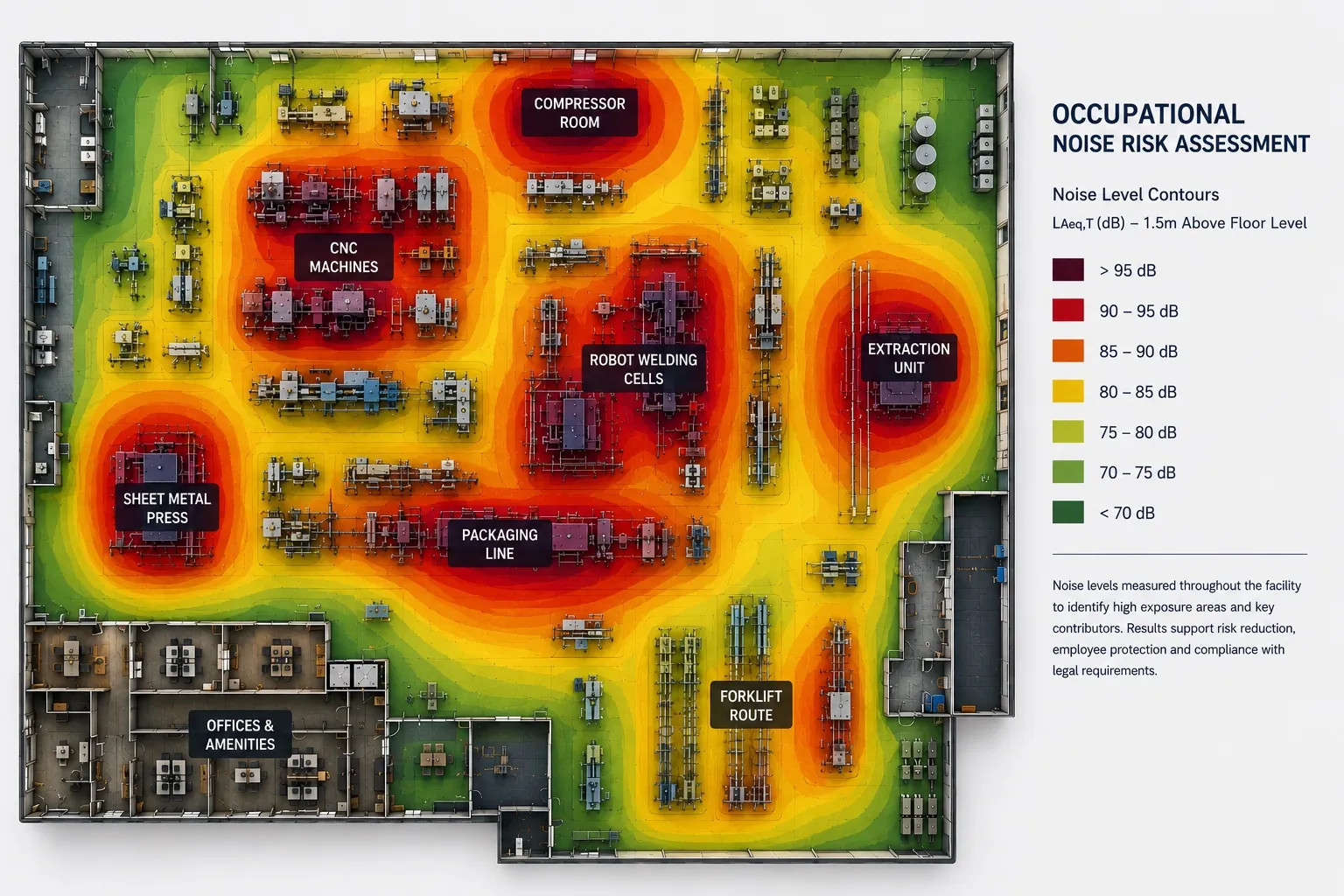
A complete workplace noise and vibration service covering occupational noise surveys, personal dosimetry, exposure assessment and noise mapping, together with guidance on hearing protection, regulatory requirements and the design and implementation of practical noise control solutions.
Assessment of employee noise exposure based on actual tasks, shift patterns and operating conditions, including daily personal exposure and peak sound pressure levels.
Personal dosimetry for mobile, variable or unpredictable roles, combined with attended measurements to understand both employee exposure and the sources driving it.
Workplace noise surveys and contour mapping to identify high-noise areas, support hearing protection zone definition and signage, and rank the plant or processes contributing most to exposure.
Assessment of hand-arm vibration from powered tools and whole-body vibration from vehicles, mobile plant and work platforms, based on task duration and measured or assessed vibration magnitude.
We review tasks, shift patterns, plant, processes and existing controls to identify employee groups and the operating conditions that need to be assessed.
Our engineers undertake attended noise measurements, personal dosimetry and vibration measurements where required during normal operation.
We calculate occupational noise and vibration exposure, compare the results against the applicable action and limit values, identify high-noise areas and rank the sources contributing most to risk.
The findings are translated into clear actions: engineering and organisational controls, hearing protection and zoning requirements, signage advice and practical priorities for reducing exposure.
Allegro Acoustics has delivered workplace noise and vibration assessments for clients across life sciences, manufacturing, food production, power generation and heavy industry. Explore some of our previous work below.

Workplace noise exposure assessment on a live food production site.

Occupational noise exposure assessment across engine maintenance and test operations.

Workplace noise assessment across a live hydro-electric generating asset.
Under the Safety, Health and Welfare at Work (General Application) Regulations 2007, employers must make a suitable and appropriate assessment where employees are liable to be exposed above the lower exposure action value. For noise, the lower daily exposure action value is 80 dB(A).
As a practical indicator, the Health and Safety Authority advises that noise may present a risk where people have to raise their voices to be clearly heard approximately two metres apart.
The scope depends on the workplace, but typically includes a review of employee tasks and exposure groups, attended sound level measurements, personal dosimetry where appropriate, assessment of daily and peak exposure, noise mapping or source ranking where useful, and clear recommendations for controlling identified risks.
Yes. Typical operating conditions are normally essential to an accurate assessment. The survey is planned around production, shift patterns and employee activities so that the measurements reflect real exposure while minimising disruption to the site.
Often, yes. Where employees are exposed to powered tools, vehicles or other vibration sources, hand-arm or whole-body vibration can usually be incorporated into the same assessment programme. The vibration exposure is assessed separately against its applicable action and limit values. The same General Application Regulations also cover workplace vibration, under a separate chapter dealing with hand-arm and whole-body vibration.
Relevant sectors: Life Sciences · Manufacturing · Power Generation & Data Centres
Related services: Environmental Noise Monitoring · Planning Noise Assessments · Industrial Noise Control · Building Acoustics

Your enquiry is on its way. We'll be in touch shortly.