Noise modelling predicts how sound from one or more sources will propagate across a site and into the surrounding area, accounting for distance, buildings, terrain, barriers, ground conditions and the position of the receptors affected. The output supports planning applications, industrial noise management and mitigation design, before anything is built or bought.
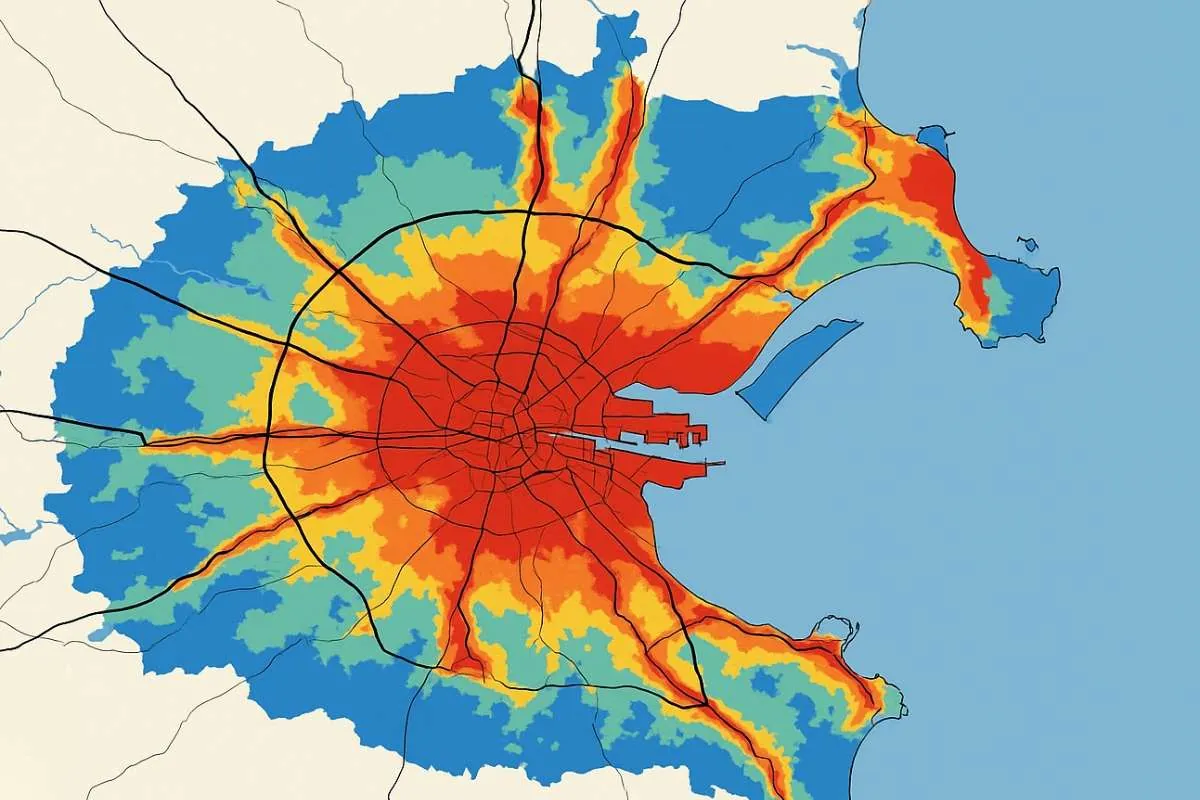
Noise modelling is the use of a predictive acoustic model to calculate how sound will travel from a source, or a set of sources, across a site and into the surrounding environment. Rather than measuring what already exists, the model calculates what a proposed development, an existing facility, or a mitigation scheme would sound like at any point of interest, based on the sound power of the sources, the geometry of the site and the way sound propagates outdoors.
This is different to a noise survey, which measures existing conditions at a fixed set of locations. A model can predict levels anywhere on a site, test scenarios that do not yet exist, such as a proposed plant layout or a barrier that has not been built, and identify which sources are actually driving the noise at a given receptor.
This guide covers environmental and industrial noise modelling, meaning how sound propagates outdoors from plant, processes and developments to nearby receptors. It is a related but distinct discipline to room acoustic modelling, which simulates reverberation, speech intelligibility and internal sound quality within a building, and is covered in our guide to acoustic modelling. Workplace noise mapping addresses employee exposure within a facility and is covered separately in our Workplace Noise & Vibration guidance.
A noise map is one of the outputs of a noise model, not the model itself. Once a model has calculated sound levels across a site and the surrounding area, those results can be plotted as a contour map, showing bands of predicted level, for example the area falling above and below a given contour, overlaid on the site layout or an aerial photograph.
Noise maps are useful because they show impact at a glance: where levels are highest, which receptors are closest to the loudest contours, and how a proposed barrier or enclosure changes the picture. A map is normally one part of a wider reporting package that also sets out the underlying data, the receptor-by-receptor predictions and the assumptions behind the model, since a map on its own does not explain why the levels are what they are.
A model is only as reliable as the data used to build it. Depending on the project, the inputs typically include:
The quality of a model's output depends heavily on the quality of this input data, and on the assumptions made wherever measured data is not available. A model built on assumed sound power levels and a simplified site layout will still produce a result, but it will not carry the same weight as one built on measured source data and a surveyed site. Being clear about which inputs are measured and which are assumed is part of a credible model, not an afterthought.
Once the inputs are in place, the model calculates how sound travels from each source to each receptor. In practical terms that means accounting for:
None of these effects act in isolation, and a competent model has to combine them correctly for the site rather than apply a single blanket correction. This is where engineering judgement, not just the software, determines whether a result is credible.
A model is a prediction, and a prediction should be checked against reality wherever that is possible. Where a source already exists, its measured sound power can be used directly, rather than relying on a manufacturer's figure or an assumed value. Where a broader baseline noise survey is available, predicted levels at a receptor can be compared against measured levels under similar conditions, and the model refined until that comparison is acceptable.
This process, sometimes described as calibration or validation against field measurements, is about refining assumptions where measurement shows the model is off, not proving the model is correct in some absolute sense. A model that has been calibrated against measured data is more credible than one built entirely on assumptions, but every model still carries some uncertainty, and a competent report says so rather than presenting a single number as certain.
Predictive noise modelling is often used within a noise impact assessment to estimate levels at nearby noise-sensitive receptors before a development is built, so options can be tested and mitigation designed before construction rather than after a complaint. The model typically covers the proposed plant, traffic movements or construction activity most likely to affect the surrounding area, and the results are reported against the applicable planning or licensing criteria and used to support the wider planning submission, including responses to a Request for Further Information.
Modelling is not only used before a site is built. On an operating industrial site, it is one of the most effective ways to work out which of several sources is actually responsible for an exceedance or a complaint, rather than treating every item of plant as equally responsible. Sound power measurements of individual plant, fed into a model of the site, show what each source contributes at the boundary and at the nearest receptor, and which ones dominate the result.
That matters because it changes what gets fixed. A site facing an Industrial Emissions Licence condition, an EPA requirement, or a recurring community complaint can use the model to prioritise controls against the sources that actually matter, test the effect of a plant change or relocation before it happens, and run scenarios, such as a new production line or additional cooling capacity, before committing to a layout. Our environmental noise monitoring service provides the measured baseline a model like this is built and checked against.
The most valuable use of a noise model is testing what a mitigation option would achieve before it is bought, fabricated or installed. Barriers, screens, enclosures and silencers can all be added to a model and their predicted effect calculated at every receptor of interest, so several options can be compared, on paper, against their likely performance and their cost.
In practice this covers a wide range of measures: the height and position of a barrier, the attenuation of a louvre or acoustic screen, the specification of an enclosure or in-duct silencer, relocating or reorienting a piece of plant, or selecting lower-noise plant at the procurement stage rather than treating a noisy one after installation. Operational changes, such as restricting the hours a source runs or the sequence in which plant starts up, can be modelled the same way. Testing these options in the model does not guarantee that the measured result will match the prediction exactly, but it means money is committed to a scheme that has already been shown to be worth building, rather than one nobody has actually tested. Where engineered treatment is the outcome, our industrial noise control service carries the design through to installation and verification.
Allegro Acoustics uses SoundPLAN for environmental and industrial noise modelling. It builds a three-dimensional model of the site incorporating terrain, buildings, barriers and source data, calculates propagation to each receptor of interest, and produces the noise contours used in reporting. Multiple scenarios, existing conditions, a proposed development, or a mitigation option, can be modelled and compared within the same site model.
The software calculates what it is given. Its value on a project comes from the quality of the source data going in and the engineering judgement applied to interpreting what comes out, not from the software itself. Two models built in the same package can produce very different, and very differently credible, results depending on how they were set up.
Need noise modelling for a planning application? Allegro Acoustics combines baseline measurements, source and site data, three-dimensional noise modelling and mitigation assessment with clear technical reporting for planning applications and EIAR.

Your enquiry is on its way. We'll be in touch shortly.