Acoustic modelling simulates how sound behaves in a space. Using the data, design, performance and compliance can be optimised...
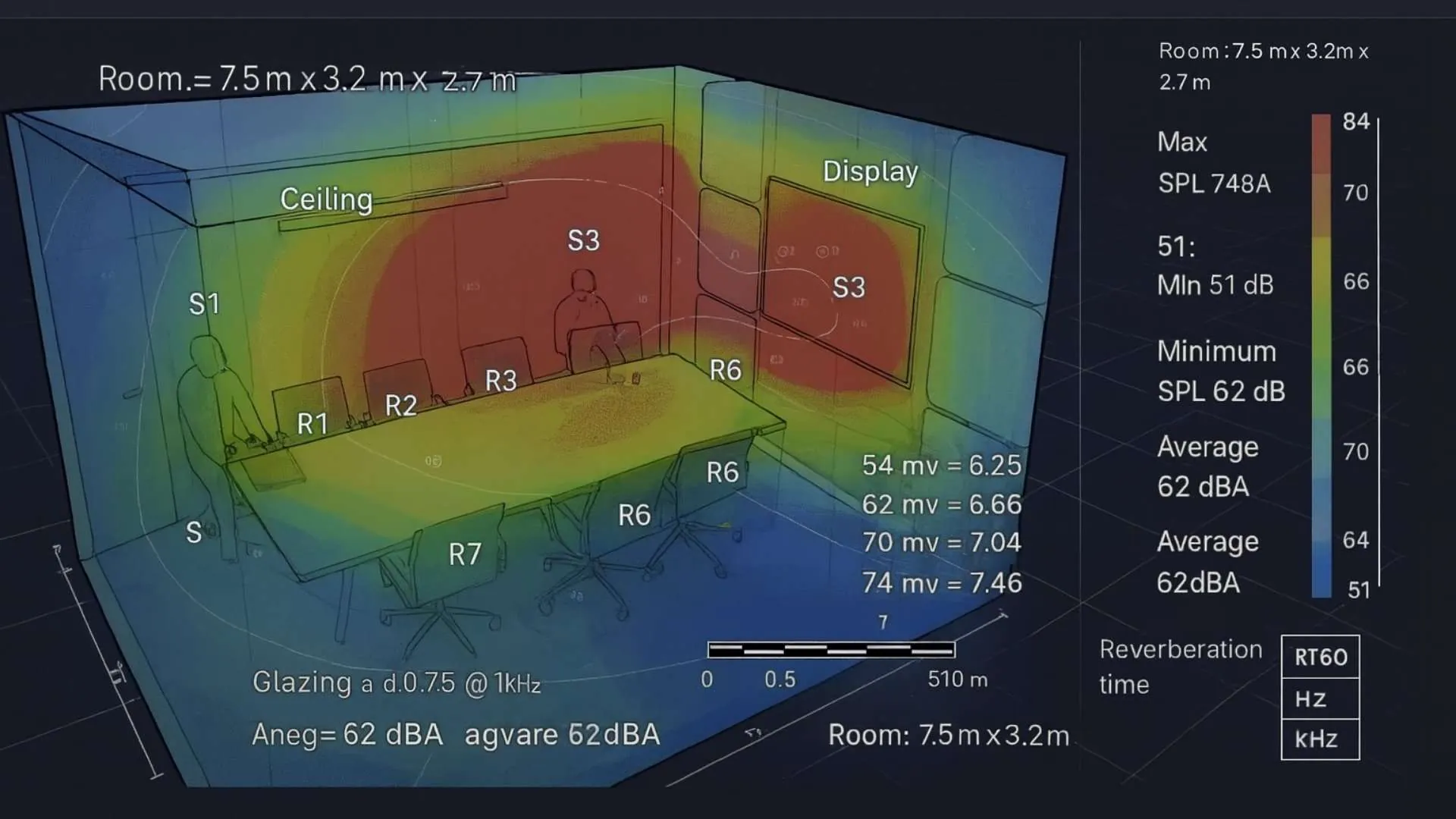
It’s important to understand how sound behaves. It allows us to predict how a building will perform, from an acoustic and noise perspective. Used in industrial, architectural and urban development contexts, modelling supports precise design and regulatory compliance. It shows us how sound energy moves through, and around structures. This predictive information helps optimise materials, layouts and acoustic treatments to achieve high performance, and meet compliance standards.
Sound Pressure Level, in decibels (dB), is a measurement of sound intensity. In acoustic modelling, SPL helps visualise how loudness varies in a space, identify potential hot-spots, and verify that regulatory thresholds are not exceeded.
Sound waves interact with surfaces in three key ways: reflection, absorption, and transmission. Hard materials reflect sound, soft or porous materials absorb it, and partitions may transmit it to adjacent spaces.
Ray tracing simulates how sound rays travel and reflect through a 3D model. It’s particularly useful for predicting reverberation and speech intelligibility in rooms.
Auralisation converts the data from an acoustic model into an audible format, allowing clients and designers to “hear” a space before it’s even built. This makes it easier to evaluate different design options and compare treatments.
A 3D acoustic model is a virtual representation of a space, including geometry, materials, and sound sources. Sound engineers use these models to analyse how sound waves move and interact within complex environments. By adjusting surface materials, wall angles, or the absorption coefficient, designers can fine-tune acoustic performance and predict compliance outcomes.
In industrial settings, 3D modelling identifies noise sources and visualises how control measures affect the overall noise map. In architectural design, it provides a vital bridge between creative intent and functional performance, allowing projects to balance aesthetics with acoustic results.
Acoustic simulation uses advanced software tools to replicate how sound behaves. By processing variables, room geometry or surface properties for example, simulations generate detailed predictions of reverberation times, sound distribution, and speech clarity. These results guide design.
Acoustic simulation helps EHS and project managers identify and address potential noise issues before they impact operations.They also inform early design decisions, shaping the sound experience. Combined with 3D models, acoustic simulation turns acoustic engineering from reactive to proactive.
In modern engineering and construction, acoustic modelling plays a critical role in creating comfortable and compliant environments. By integrating sound analysis early in the design process, project teams can identify potential challenges long before they become costly on-site delays.
Acoustic modelling has the ability to anticipate how sound will behave in and around a proposed development. By simulating sound propagation in a virtual model, sources of unwanted noise can be spotted early; mechanical systems, ventilation systems or process equipment. This data enables the design team to make fast adjustments, repositioning equipment for example, before construction begins, preventing delays and disputes, delivering cost savings.
Acoustic modelling demonstrates compliance with Irish and EU noise standards, including the Environmental Protection Agency’s guidance and the ISO 1996 framework. Using accurate noise maps and predictive data, we can show that a facility or project will operate within the noise limits defined in planning conditions or Industrial Emissions Licences. This protects our clients from regulatory breaches, fines and reputational risk. It also supports engagement with local authorities..
Noise control is a key component of sustainable and socially responsible design. Acoustic modelling helps reduce the environmental footprint by limiting the impact of noise on the surrounding area. In mixed-use or residential developments, it safeguards the community, maintaining comfortable sound levels and reducing long-term noise exposure. For project managers, this translates into greater public acceptance and smoother planning approvals.
Acoustic models take many forms, each tailored to a specific aspect of how sound behaves in the real-world. Large-scale environmental noise mapping or detailed simulations of internal room acoustics and sound insulation, each model serves a unique purpose. We apply these methods across industrial, architectural and commercial projects across Ireland and the EU.
Environmental noise models are used to predict how sound propagates outdoors. This process supports planning applications, environmental assessments, and regulatory compliance. With a detailed noise map (also known as a strategic noise map) a noise expert can identify how sources may affect surrounding communities; road traffic noise or plant equipment for example. The analysis of these results inform the placement of barriers, enclosures or landscaping features to reduce environmental impact and support smooth project approval.
Inside, acoustic modelling focuses on sound quality; offices, classrooms, meeting rooms etc. We use advanced 3D simulation tools to assess reverberation time, sound absorption rates, and to predict speech clarity. By simulating how sound reflects and decays in a space, we can determine the most effective balance of absorption and diffusion materials, improving both comfort and privacy. This process directly informs our acoustic fit-out service; delivering spaces where conversations are perfectly intelligible and noise is controlled.
Sound transmission modelling assesses how noise travels through walls, floors, and other fixed barriers. It’s a crucial part of building acoustics, particularly in mixed-use developments and projects requiring a high level of soundproofing or isolation. These models are used to analyse the performance of partitions, glazing systems and other construction details to prevent unwanted sound transfer between spaces. Design weaknesses are identified early.
Different acoustic modelling methods offer varying levels of precision and complexity, depending on the type of environment being analysed. The different techniques used help engineers understand, visualise, and ultimately control sound behaviour. Combining the methods delivers accurate information, that supports better decision making, and better outcomes.
Ray tracing is one of the most widely used methods of acoustic simulation, modelling a space in 3D and tracing thousands of virtual sound rays as they reflect or absorb off of surfaces. This method creates a realistic picture of how sound behaves within complex geometries, an auditorium for example, or open-plan offices. Predictive sound analysis allows us to test how design changes affect reverberation, clarity and speech. The data informs smarter design, reducing the risk of issues.
For more detailed, frequency-based analysis, Finite Element (FEM) and Boundary Element (BEM) methods are used. These numerical modelling techniques divide a structure into small, more manageable elements, allowing for more precise calculation of how sound waves interact with materials. FEM is ideal for analysing sound behaviour inside enclosures, machinery, or complex building assemblies, while BEM evaluates external noise propagation and vibration coupling. These methods provide a level of accuracy that traditional acoustic modelling cannot achieve, particularly for low-frequency or structurally sensitive environments.
Auralisation brings acoustic modelling to life, allowing those involved in the project’s design to “hear” what a space will sound like before it’s built. Using data from 3D models and simulations, a realistic sound rendering is generated, that replicates reverberation, reflections and clarity within the proposed environment. For our clients, it transforms an abstract design concept into an audible experience.
Acoustic modelling is a powerful design and diagnostic tool. By combining predictive simulation with field data, it helps clients understand how sound behaves in real-world conditions. The following examples illustrate how different types of acoustic modelling deliver measurable results in various situations.
In manufacturing environments, noise modelling plays a role in compliance with Industrial Emissions Licences (IEL). 3D models of plant layouts simulate noise from machinery, ventilation systems and the production line itself. These models identify noise sources, quantify sound levels at site boundaries and inform the placement of enclosures, barriers, or silencers. The results form the basis of a Noise Action Plan, demonstrating proactive management of industrial noise in line with EPA guidance.
In pharmaceutical manufacturing and data centre environments, acoustic modelling supports early-stage design and operational sustainability long-term. In these environments, predictive simulations manage HVAC and process noise, meeting internal targets and external environmental regulations. By modelling airflow systems, the plant floor and cooling infrastructure, we can predict how vibration and sound energy move through complex structures, and specify quieter layouts, with optimised acoustic performance.
Acoustic modelling underpins the design of environments where focus, communication and wellbeing are important. 3D simulation tools are used to analyse speech clarity, reverberation time and sound absorption in classrooms, lecture halls, hospitals, and modern offices. By testing different finishes and layouts, acoustic engineers can test design options, improving comfort and privacy. In an educational context, these enhancements can directly impact learning outcomes. In offices, they improve meeting quality and even employee health.
Urban development projects often require a predictive understanding of environmental noise before planning approval can be granted. Environmental noise maps simulate how sound from roads, railways, power stations or industrial facilities will move through the local community. These noise predictions help planners visualise potential impacts and develop mitigation strategies, noise barriers for example.
Using data on traffic flow, vehicle types and road geometry, predictive models show how noise spreads across nearby residential or commercial areas. These models support both design and mitigation, helping identify where acoustic barriers, speed management or surface materials can reduce long-term exposure.
Under Irish and EU law, local authorities are responsible for assessing and managing environmental noise in urban areas. We support councils and planning consultants with urban noise mapping and noise studies, meeting the requirements of Environmental Noise Regulations (S.I. No. 140 of 2006) and the environmental noise directive. Our models help authorities prepare Noise Action Plans and identify priority areas.
Acoustic modelling relies on specialised software tools. Industry-standard, SoundPLAN and Odeon, allow engineers to visualise, predict, and quantify acoustic performance across a range of applications; industrial and architectural.
SoundPLAN is widely used in the industry, for environmental noise modelling and strategic noise mapping. It builds detailed outdoor noise maps that reflect the terrain, building geometry and meteorological effects. This makes it particularly effective for assessing road traffic noise levels or large industrial facilities
Odeon is used primarily for room acoustic simulation. It models the reflection, absorption, and diffusion of sound in enclosed spaces, helping designers optimise for speech clarity, reverberation time, and overall sound quality in offices, laboratories, classrooms, and performance venues.
Acoustic modelling is more than a design tool, it’s the foundation of a building that sounds great, as well as looks great. It’s the combination of scientific precision and practical data. We use modelling to help clients make informed, data-driven decisions, for quieter, safer, and more sustainable outcomes. Reducing industrial noise emissions, optimising the acoustics of a workspace, or managing environmental impact, complex acoustic challenges become clear, actionable solutions.
As a trusted engineering partner, Allegro Acoustics brings decades of technical experience to the modelling process. Our team applies advanced simulation methods and 3D visualisation tools to predict how sound will behave, before a single wall is built or a single machine is installed. To talk to an acoustic modelling and noise mapping expert, click here to get in touch, and we’ll discuss your requirements…

Your enquiry is on its way. We'll be in touch shortly.